
First aid
What must a workplace first-aid kit contain in Belgium? (+ free checklist for the prevention advisor)
What belongs in a workplace first-aid kit in Belgium? Review the Code, practical checks and sector additions, with a free checklist for your company.
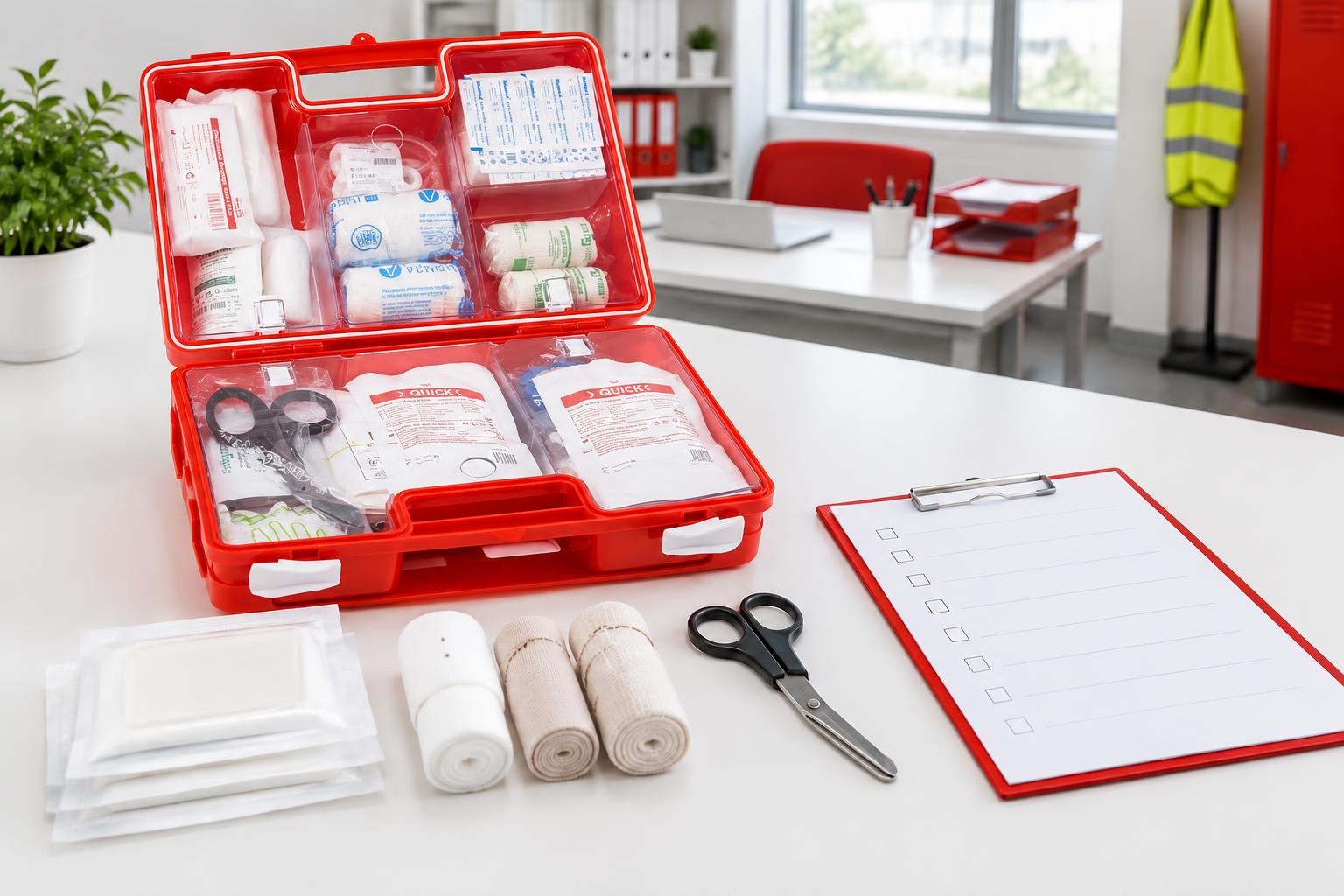
You want to put the workplace first-aid kit in order. Not because you enjoy inventories, but because you want your team to find the right equipment when they need it. Perhaps a kit is already there, but nobody knows who checks it. As a prevention advisor, you may be looking for an overview you can use between two other tasks. Or you run a small company and want to know where to start. This article helps you look at contents, accessibility and follow-up together, rather than treating the kit as an isolated purchase.
1. The short answer: there is no fixed legal list
In Belgium, there is no fixed legal contents list that is identical for every first-aid kit in every workplace. The Code on Well-being at Work, Book I, Title 5, leaves the employer to determine the necessary first-aid resources with the involvement of the prevention advisor-occupational physician. The approach needs to match the company's activities and risks. An office and a production environment therefore do not automatically need the same contents.
The Belgian Federal Public Service Employment publishes an indicative list for the first-aid box. Such a list can help you assemble or check a kit, but it is not a universal statutory minimum list. Make that distinction clear in your own documents: a practical overview supports your choices but does not replace adapting them to your workplace. The question is not just whether every box has been ticked. It is whether the resources available actually suit your company.
Do not start by ordering a new kit at random. First look at what is already available, where it is kept and which questions you want to discuss with the prevention advisor-occupational physician. That makes the eventual choice easier to understand and avoids treating a standard package as a complete answer to your company's first-aid organisation.
2. What the Code does require
First-aid organisation involves more than a box on the wall. It includes resources, people who can help, procedures and follow-up. These elements work together. Equipment is of little value if it cannot be found. Training is less useful if nobody knows the internal arrangements. A procedure remains a document if people on the workplace do not know it exists.
Turn this into four practical questions. Which resources do we have available? Who are the first aiders and how do we organise their presence? What arrangements apply when an accident happens? Who follows this up? You do not need to read a legal dossier to use this article. It is useful, however, to consider these questions together so that the kit does not become a separate purchasing decision with no connection to the people using it.
Include the people who work with the kit in your overview. A prevention advisor can organise the discussion; a business owner can ensure that the arrangements have a responsible person. Ask the prevention advisor-occupational physician to assess unclear decisions about contents. The checklist is a tool for that conversation, not a declaration that the company meets all its obligations.
3. Review the basic contents by category
Checking a kit becomes easier if you do not immediately try to assess every individual item. Work by category: wound care, dressings, protection, instruments, other and documentation. This lets you organise the contents already present and collect missing information before ordering anything. It is a way to create an overview, not to establish a new legal list of your own.
Record what you find in each category. Then review what needs replenishing, replacing or discussing. Keep contents and follow-up separate: a product can be present even though nobody takes responsibility for checking it. Equally, there may be a responsible person but no clear overview for them to use. Both deserve a place in your review, because a kit needs more than an initial inventory.
The PDF contains the review checklist with categories, suggested quantities and review points. Print it, tick the boxes and keep it with your records. The list is a practical starting point: add or remove items based on your risk assessment. Consider questions about contents alongside your risk assessment and discuss them with the prevention advisor-occupational physician.
Free first-aid checklist
Check your kit, without guesswork
Print the checklist, tick the boxes and keep it with your records.
4. Additions by sector
Your activity may create specific points to consider. For construction and industry, examples to review include eyewash, burn gel and large dressings. For hospitality, consider blue plasters and attention to burns. For schools and sport, cold packs are a point to discuss. These examples help focus the conversation by sector; they are not separate legally standardised packages or automatic requirements for every business in that category.
An office also deserves a deliberate choice. Its basic contents should suit the workplace, and the kit should remain accessible and straightforward to check. A quiet office environment is not a reason to forget first-aid organisation. Start with the categories above and have the necessary resources assessed in the context of your company, rather than assuming that any box sold for offices will settle every question.
Does your company have different activities or several locations? Do not review the kits solely from the head office's perspective. Record where contents or arrangements differ and discuss the choices for each location. You do not need to solve every question yourself before asking for advice. A clear overview of what is present and what remains uncertain is already a useful starting point for a practical conversation.
5. The five classic mistakes
Expired products. A full kit looks reassuring, but the presence of products alone does not tell you whether the contents are still usable. Include expiry dates in the overview and specify who follows up on the checks. Do not rely solely on the fact that the kit was bought new at some point in the past.
An empty kit after an accident. Used equipment needs replenishing. Without an arrangement, that job can easily remain unfinished among other tasks. Make clear who reports that material has been used and who organises the refill, so that the kit is in order after its first use as well as before it.
Nobody is responsible. When the kit belongs to everybody, its follow-up can end up belonging to nobody. Name a responsible person and make that arrangement visible in your way of working. This is about practical ownership, not adding another form that receives no follow-up and does not change what happens on the workplace.
The kit is locked away. Equipment that cannot be reached when needed provides little support. Review whether people can find and access the kit. Walk the route from the places where your employees work, instead of assessing its location only on a document or assuming that everyone already knows where it is kept.
Equipment is available, but nobody knows what to do. A good purchase does not replace first aiders, procedures or guidance during an accident. Check the arrangements around the box as well as the box itself. This keeps equipment and action connected and avoids an inventory becoming the only visible part of first-aid preparation.
6. A kit helps only when someone knows what to do
A first-aid box and an Actibox play different roles. The box contains equipment; the Actibox provides an action card for each type of accident with a step-by-step plan. This also gives untrained colleagues guidance when they need to help. The cards do not replace training or the company's own arrangements, but make concrete actions visible on the workplace.
Would you like to see what that looks like? Free readable examples are available on Action cards. If you want to discuss contents, training or follow-up together, you can send a request. You do not need a complete purchasing plan before starting the conversation, or a perfectly finished inventory before asking for help with the open questions.
7. Make one workable overview
Start small: look at the kit, note the unresolved points and assign responsibility for follow-up. Use the checklist to organise the review. Want to look at first aiders, AEDs, evacuation and guidance during an accident too? Take the Safety Quickscan below. You receive an indicative overview with three next steps, not a legal inspection or a certificate of compliance.
Sources: Belgian FPS Employment — First aid and Code on Well-being at Work, Book I, Title 5.
The right action, straight away?
ActiBox puts 25 action cards on your wall — practical step-by-step guides for every workplace emergency, in Dutch, French or English.
View the ActiBox